November 24, 2020

Course Announcement: "Conceptual Foundations of Statistical Learning" (36-465/665, Spring 2021)

Attention conservation notice: Self-promoting notice of a class at a university you don't attend, on an arcane subject you're not that interested in, presuming background you don't have.

Coming terrifyingly soon:

Conceptual Foundations of Statistical Learning (36-465/665), Spring 2021
Description: This course is an introduction to the core ideas and theories of statistical learning, and their uses in designing and analyzing machine-learning systems. Statistical learning theory studies how to fit predictive models to training data, usually by solving an optimization problem, in such a way that the model will predict well, on average, on new data. The course will focus on the key concepts and theoretical tools, at a mathematical level accessible to students who have taken 36-401, "modern regression" (or equivalent) and its pre-requisites. The course will also illustrate those concepts and tools by applying them to carefully selected kinds of machine learning systems (such as kernel machines).
Time and place: Tuesdays and Thursdays 2:20--3:40 pm, Pittsburgh Time, via Zoom
Pre-requisites: Undergraduates taking the course as 36-465 must have a C or better in 36-401. Graduate students taking it as 36-665 are expected to have similar background in the theory and practice of linear regression models, linear algebra, mathematical statistics, probability, and calculus in multiple variables.
Topics in brief (subject to revision): Prediction as a decision problem; elements of statistical decision theory; "risk"; "probably approximately correct"; optimizing on training data; the origins of over-fitting; deviation inequalities; uniform convergence and concentration inequalities; measures of model complexity (Rademacher complexity, VC dimension, etc.); "algorithmic stability" arguments; optimizing noisy functions; regularization and its effects on model complexity; model selection; kernel machines; random-feature machines; mixture models; and some combination of stochastic-process prediction, sequential decision-making/reinforcement learning, and low-regret ("on-line") learning.
This course vs. alternatives: Students wanting exposure to a broad range of learning algorithms and their applications would be better served by other courses, especially 36-462/662 ("data mining", "methods of statistical learning"), 10-301/601 ("introduction to machine learning") or 10-701 ("introduction to machine learning" for Ph.D. students). This class is for those who want a deeper understanding of the underlying principles. It will mean a lot more math than coding, and it won't help you move up a leader-board, but it will help you understand the statistical reasons why learning machines work (when they do).

I have until classes begin on 1 February to figure out how I am actually going to make this happen.

Corrupting the Young; Enigmas of Chance

Posted at November 24, 2020 18:25 | permanent link

October 31, 2020

Books to Read While the Algae Grow in Your Fur, October 2020

Attention conservation notice: I have no taste, and no qualifications to opine on the history of philosophy, or on historical materialism.

Susan Hill, The Woman in Black
An extremely creepy and effective ghost story.
Bertrand Russell, A History of Western Philosophy
I imprinted on this as a teenager and deeply enjoyed the re-read. If you want to tell me that there are mis-interpretations of your favorites and superior scholarship and blah blah blah, I will believe you, mostly. But I will also ask you to appreciate the spectacle of a genuinely great philosopher earnestly engaging with the history of the tradition that shaped him, and how that tradition had lived in the world. §
Andrea Fort et al., Songs for the Dead [1, 2]
Comic book mind candy, near the border between fantasy and horror. This is secondary-world fantasy where the questing heroine is. in fact, a necromancer who constantly surrounds herself with the shambling, walking dead; it's also as heart-warming as possible, under the circumstances. §
--- Conclusion to the trilogy
Elizabeth Hand, Wylding Hall
One of the most eerie haunted-house stories I've ever read. It manages to rival The Haunting of Hill House, while being very much its own scary, musical thing. §
Anna Lee Huber, A Stroke of Malice
Mind candy historical mystery, latest in the on-going series. Not deep, but reliably enjoyable. §
Cherie Priest, The Family Plot
Mind candy Southern-Gothic horror. I guessed some Awful Secrets early on, and, well, I never do that. §
Laird Barron, The Beautiful Thing That Awaits Us All
Mind candy, Lovecraftian-derived short stories. (Though Thomas Ligotti might be a more direct influence?) Barron has a strong reputation, but, after this first encounter with his fiction, I cannot understand why. Everything from the supernatural horrors through the world-weariness to the unbelievable and stiff characters feels third hand. Bah. §
Perry Anderson, In the Tracks of Historical Materialism and The Antinomies of Antonio Gramsci
Tracks is basically a post-script to Considerations on Western Marxism, bringing the story up to the early 1980s. This includes a seemingly off-hand endorsement of Alec Nove's The Economics of Feasible Socialism. This baffles me, because Nove is very blunt about how Marxism has absolutely nothing to contribute to actually organizing a socialist economy, and indeed his great book is one of the classics of market-socialist thought. This is however just a passing oddity; like its predecessor, Tracks largely passes over questions of mere economics in favor of High Theory.
Antinomies is a highly detailed look at contrasting pairs of concepts in Gramsci's writings, e.g., "war of position" vs. "war of movement". (I don't think this was just lingering structuralism.) In doing so, Anderson tries to be equally attentive to the historical context in which Gramsci was writing and what uses leftists might make of them "now" (1976). Why Anderson thought it so important to engage in such intense exegetical labors on Gramsci, I couldn't say. (I could make some guesses.)
For both books, some prior acquaintance with the authors under discussion will be very helpful. Anderson is good at exposition, when he chooses to exposit, but he takes a lot as read. §
Books to Read While the Algae Grow in Your Fur; Scientifiction and Fantastica; The Progressive Forces; Philosophy; Writing for Antiquity; Pleasures of Detection, Portraits of Crime; Tales of Our Ancestors; Cthulhiana

Posted at October 31, 2020 23:59 | permanent link

September 30, 2020

Books to Read While the Algae Grow in Your Fur, September 2020

Attention conservation notice: I have no taste, and no credentials to opine on the history of Marxism, sociology, or even social network analysis.

Anna Lee Huber, An Artless Demise
Mind candy historical mystery, 7th in the series; continuing to be enjoyable.
Perry Anderson, Considerations on Western Marxism
A brisk survey of Marxist thought from continental western Europe*, 1918--1968, which proceeds from the premises that (1) real Marxist insight is directly translatable into, and derives from, joining the working class in revolutionary action, and (2a) Lenin fulfilled these conditions and accordingly made great advances in Marxist theory, as well as (2b) founding a genuinely proletarian state. As Anderson brings out, all the western Marxist theorists he surveys (except Gramsci) were children of the middle or even upper classes, and were philosophers disconnected from concrete questions of politics (except Gramsci) and economics. It is thus suggestive that a lot of what they did was combining classical Marxism with other philosophies or ideologies (psycho-analysis, existentialism, structuralism), in writings too obscure for most people with university educations, let alone contemporary workers. (Such syncretism of apparently-incompatible traditions, in increasingly arcane prose, is very common when communities of literate intellectuals are left to their own, inward-looking devices [cf.].) Anderson trembles on the verge of a historical-materialist analysis of western Marxism as, in fact, an ideology of (a fraction of) the educated professional classes, but doesn't quite go there, perhaps because he thinks those works were intellectually valuable — and in any case Anderson spent a lot of his career importing this stuff into English-speaking, especially British, intellectual life.
A rather extraordinary concluding chapter points out that there was in fact another Marxist tradition in western Europe which did try to be revolutionary and keep its eye on politics and even economics, namely Trotskyism. Anderson ends by saying, or at least strongly hinting, that there needed to be some synthesis between the Trots and the philosophers.
An even more extraordinary afterword, from a decade later, walks back premise (1). The new argument is that historical materialism is supposed to be a science of history, and practical action in the present can't change the past, so correct Marxism can't be all about the unity of theory and practice. (The afterword does not re-examine premise (2b), about how Lenin founded a workers' state.) This shows commendable intellectual honesty and willingness to revisit ideas on Anderson's part, but does raise a lot of "Where else were you confidently wrong about?" questions.
Still, if you are willing to accept, or mentally divide through for, premises (1) and (2), this is a really good high-level survey of half a century of left-wing thought, from a very learned and intelligent commentator. The best alternative I can think of is volume III of Kolakowski's Main Currents of Marxism, but this is vastly shorter, if more schematic. (I would pay a lot to read Anderson and Kolakowski seriously reviewing each other.)
*: Anderson mentions British Marxist historians, but doesn't discuss their work; no other Marxist historians get referred to. As for Marxist economists, he mentions Sweezy in the USA and Sraffa in the UK, but mostly to say that they marked end-points for the tradition of distinctively Marxist economics, Sweezy by hybridizing it with Keynes, Sraffa by, well, whatever the hell it was Sraffa was up to. (That last is a jest but I'm actually curious about Anderson's thoughts on Sraffa.)
Norman Geras, Marx and Human Nature: Refutation of a Legend
The legend is that Marx thought there was no such thing as a trans-historical, universal human nature, that he dissolved into the "ensemble of social relations" which are so malleable that the idea is meaningless. Geras is very, very patient in picking apart all of the textual evidence offered on behalf of this, and countering it with all of the places where Marx plainly does rely on the idea of an un-changing human nature. Geras is also very patient in distinguishing "There is no trans-historical human nature" from "X, which is claimed to be part of trans-historical human nature, is no such thing but a product of a particular ensemble of social relations", and distinguishing between "Marx asserted that there was such a thing as human nature" and "Marx was right about the content of human nature" and "Marx was right to assert that there was such a thing as human nature".
Linton C. Freeman, The Development of Social Network Analysis: A Study in the Sociology of Science
This is a self-published history, by a participant, so it's not very sophisticated historiographically. (There is little or no attempt to trace the development of any individual's thoughts, or explain how the idea of network analysis took off, or failed to, in particular contexts, for instance.) But it's good on bringing together all the different strands and efforts that contributed to the field of social network analysis, within sociology, as that was understood circa 2000. Something which astonished me, though, was to learn that Harrison White was in fact a Ph.D. physicist (and former Carnegie Tech faculty).
Erik Olin Wright, Understanding Class
A collection of Wright's essays and reviews on the theme of what classes are, how they work, and why some essential core of Marxism is true, dammit, even if Uncle Karl's original formulations are indefensible.
Flavor
Valen the Outcaste [1, 2]
The Spider King
Comic book mind candy, fantasy flavors, no pun intended. (Technically Spider King is science fiction.)

Books to Read While the Algae Grow in Your Fur; The Progressive Forces; Philosophy; Commit a Social Science; Networks; Pleasures of Detection, Portraits of Crime; Scientifiction and Fantastica

Posted at September 30, 2020 23:59 | permanent link

August 31, 2020

Books to Read While the Algae Grow in Your Fur, August 2020

Attention conservation notice: I have no taste, and no qualifications to opine on the economics of the Internet or its implications.

I omit a number of books I read this month and didn't care for, but where my attempts at critique seem mean-spirited even to myself, and, worse, unlikely to inform anyone else. \[ \newcommand{\Expect}[1]{\mathbb{E}\left[ #1 \right]} \DeclareMathOperator*{\argmin}{argmin} \]

Christopher C. Heyde, Quasi-Likelihood and Its Application: A General Approach to Optimal Parameter Estimation [SpringerLink]
The most basic sort of quasi-likelihood estimator is for regression problems. It requires us to know the model's prediction for the conditional mean of \( Y \) given \( X=x \), say \( m(x;\theta) \), and the conditional variance of \( Y \), say \( v(x;\theta) \). It then enjoins us to minimize variance-weighted squared errors: \[ \hat{\theta} = \argmin_{\theta}{\frac{1}{n}\sum_{i=1}^{n}{\frac{\left(y_i - m(x_i;\theta)\right)^2}{v(x_i;\theta)}}} \] Equivalently, we solve the estimating equation \[ \frac{1}{n}\sum_{i=1}^{n}{\frac{\nabla_{\theta} m(x_i;\theta)}{v(x_i;\theta)} \left(y_i - m(x_i;\theta)\right)} = 0 \] (I've left in the \( \frac{1}{n} \) on the left-hand side to make it more evident that this last expression ought to converge to zero at, but only at, the right value of \( \theta \).)
This is what we'd do if we thought \( Y|X=x \) had a Gaussian distribution \( \mathcal{N}(m(x;\theta), v(x,\theta)) \); the objective function above would then be (proportional to) the log-likelihood. But there are many situations where a quasi-likelihood estimate works well, even if the real distribution isn't Gaussian. If we're dealing with linear regression functions, for instance, the Gauss-Markov theorem tells us that weighted least squares is the minimum-variance linear estimator, Gaussian distribution or no Gaussian distribution.
Heyde's book is about a broad family of quasi-likelihood estimators for lots of different stochastic processes. The basic idea is to find functionals of these processes which involve both the data and the parameters, which will have expected value zero at, but only at, the right parameters. (As with \( Y_i - m(X_i;\theta) \) in the regression example.) More exactly, Heyde enjoins us to look for functionals which will be martingale difference sequences. We then form linear combinations of these functionals and solve for the parameter which sets the combination to zero. (That is, we solve the estimating equation.) The best weights in this linear combination (generally) reflect the variation in the martingale increments. This is an extremely flexible set-up which nonetheless lets Heyde prove some pretty useful results about the properties of his estimators, for a wide range of parametric and non-parametric problems involving stochastic processes.
Recommended for readers who have both a sound grasp on likelihood-based estimation theory for IID data, and some knowledge of stochastic differential equations and martingale theory. But good for those of us with those peculiar deformations. §
(I have been reading this, off and on, since 2002, but I have a rule about not recommending books until I've read them completely...)
Mike Carey and Elena Casagrande, Suicide Risk (vols. 1, 2, 3, 4, 5, 6)
High quality comic book mind candy. It's somewhat reminiscent, in style and theme, of classic Roger Zelazny (especially Creatures of Light and Darkness and Lord of Light), to the point where I'd be surprised if there wasn't direct influence. This is, to be clear, a good thing. §
Nowhere Men
Forgotten Home
Lady Killer
Hobo Mom
Further comic book mind candy, assorted (no particular order). I'd read sequels to the first two.
John McWhorter, Language Families of the World
McWhorter is always at his best as a spirited and engaging expositor of linguistics to non-linguists.
Matthew Hindman, The Internet Trap: How the Digital Economy Builds Monopolies and Undermines Democracy [JSTOR]
This is rather convincing, especially when it comes to the extreme inequality of attention online (*), how little of that goes to local news, and why that does, indeed, undermine democracy. One aspect of his explanation for all this is that using the Internet is very cheap because massive sums go into building the Internet. That is, providing a service like a search engine, that covers as much as users have come to expect, with results of competitive quality, and which handles huge numbers of users at high speed, requires massive investments in computing hardware, interface design, back-end software design, data acquisition, data storage, etc. This creates very substantial barriers to entry, which are not going to go away. (Even Microsoft, throwing billions of dollars and incredible other resources at the problem, is barely competitive in search with Google.) Having assembled all this infrastructure, of course, the marginal cost of running one extra search on it is trivial, but the cost of getting to the first query is formidable. And similarly for streaming video, or doing just about anything else at "Internet scale".
I found this argument completely convincing, but then I learned my Brian Arthur at my father's knee.
There are also some economic models of why he thinks this inequality is intrinsic to the Internet, which are adaptations of the New Economic Geography models of Krugman et al. Now, I have to say I do not think very much of these. The models presume that consumers have a taste for quality and a taste for rapidity of updates from content providers, and that the quality and the number of updates simply multiply together to give consumer utility. But this plainly implies that our ideal is to be alerted continually to content we can just barely stand, and this only sounds like an accurate description of Twitter. The equilibria would change drastically if he allowed for a decreasing marginal utility of updating frequency. I don't think these models add all that much to the more empirical parts of the book, or the basic points about increasing returns. §
*: Portions of it are devoted to arguing that online attention follows a strict power law. I don't think this is really necessary to the argument --- Hindman uses pure resampling in his simulations, so evidently he doesn't think so either --- but I do wish he'd not cite our paper and then go on to use methods we demonstrated are just bad. But this is me taking one of my hobby-horses for a turn around the ring, rather than a serious complaint. ^

Books to Read While the Algae Grow in Your Fur; Commit a Social Science; Pleasures of Detection, Portraits of Crime; Scientifiction and Fantastica Enigmas of Chance; The Dismal Science; Actually, "Dr. Internet" Is the Name of the Monsters' Creator; Linkage; Power Laws

Posted at August 31, 2020 23:59 | permanent link

July 31, 2020

Books to Read While the Algae Grow in Your Fur, July 2020

Attention conservation notice: I have no taste, and no qualifications to say anything about climatology, central Asian history, W. E. B. Du Bois, criminology, or post-modernity.

Samuel S. P. Shen and Richard C. J. Somerville, Climate Mathematics: Theory and Applications
I wanted to like this book much more than I did. It goes over some important pieces of math, not just for climatology but for lots of STEM fields, and the aim is "here's the main idea and how you use it, and leave the rigor to those who want it"; and it handles numerics in R. I was hoping to assign, if not all of it, then at least large chunks to my class on spatio-temporal statistics. As it is, I will just mine it for examples, but I won't even feel totally confident in that, unless I re-do them all.
To illustrate why, the final chapter is on "R Analysis of Incomplete Climate Data". This is good thing to include in an intro book, because (as they quite rightly say) real data sets almost always have missing values. They use a temperature data set from NCAR where missing values have been coded as -999, which is usually a bad practice (the Ancestors standards committees on floating-point numerical computation gave us NA for a reason), but, since they're Celsius temperatures, a value below absolute zero should be a warning to an alert user. After doing several examples where the -999.00s are taken literally, Shen and Somerville correctly say that coding missing values as -999.00 "can significantly impact the computing results" --- so "We assign missing data to be zero" (p. 286)! (Their code does not assign re-assign -999.00s to be zero, but without such a missing re-assignment their code would not produce the figure which follows this piece of text.) Even more astonishing, in section 11.4 (pp. 295ff), they handle this in the correct way, by replacing the -999s (strictly, values under -490) with NAs. In between, in section 11.3 (pp 293--295), they fit 9th and 20th (!) order polynomials to an annual temperature series from 1880--2016. "The choice of the 20th-order polynomial fit is because it is the lowest-order orthogonal polynomial that can mimic the detailed climate variations... We have tried higher-order polynomials which often show an unphysical overfit." (p. 294) --- I bet they do! The term "cross-validation" does not appear in the index, or I believe in the book. These are especially gross mis-steps, but I fear that stuff like this is could lurk in any of the data-analytic examples.
Other errors / causes of unhappiness (selected):
  • Pp.127--128, the chemical symbol for helium is repeatedly given as "He2", though helium is, of course, a monoatomic gas (with an atomic weight of 3 or 4, depending on the isotope).
  • P. 141, "Clearly the best linear approximation to the curve \( y=f(x) \) at a point \( x=a \) is the tangent line at \( (a, f(a)) \)", with slope \( f^{\prime}(a) \). This is not clear at all! If you want approximation at that point only, any line which goes through that point will work equally well, regardless of its slope. If you want approximation over some range, then the slope of the optimal linear approximation (in the mean-squared sense) is given by \( \mathrm{Cov}(X, f(X))/\mathrm{Var}(X) \), which will equal \( f^{\prime}(a) \) if \( f(x) \) is a linear function. Now over a sufficiently narrow range, a well-behaved function will be well-approximated by the tangent line, i.e., a first-order Taylor approximation will work well. What counts as a "sufficiently narrow range" will depend on (i) how good an approximation you demand and (ii) the size of the remainder in Taylor's theorem. Since that remainder is \( \propto (x-a)^2 f^{\prime\prime}(a) \), we need \( |x-a| \) to be negligible compared to \( 1/\sqrt{|f^{\prime\prime}(a)|} \), which is a measure of the local curvature of the function. Requiring \( |x| \ll 1 \), as the authors do repeatedly, is neither here nor there.
  • The book opens on a chapter with dimensional analysis. There is a good point to make here, which is that the units on both sides of an equation need to balance, and so the arguments to transcendental functions (like \( e^x \) or \( \log{x} \) or \( \sin{x} \) or \( \Gamma(x) \)) should be dimensionless (generally, ratios of quantities with physical dimensions). This is a good way to avoid gross mistakes. But of course you can always make the units balance by sticking in the appropriate scaling factor on one side or another of the equation *. (When you do linear regression, \( Y = \beta X + \mathrm{noise} \), the units of \( \beta \) are always \( \frac{[Y]}{[X]} \), and, e.g., an ordinary least squares estimate will respect this by construction.) Our authors want however to persuade the reader that dimensional analysis is a way to "discover useful formulas or laws of physics". Exhibit A for this is a purported derivation of the equation for the period \( \tau \) of oscillation of a pendulum of length \(l \) (\(\tau \propto \sqrt{l/g} \)) from sheer manipulation of units. Which is absurd, of course. Why should the period be a product of powers of the pendulum bob's mass, its length and the acceleration due to gravity alone? Even if we insisted on it being a product of powers of parameters, what about the amplitude of the oscillation (units: maximum horizontal displacement from the vertical axis), or the friction of the air, and/or the friction at the pivot point, and/or the speed of sound in the air, and/or the speed of sound in the pendulum rod? Dimension-juggling, in this case, happens to give the correct answer, once the right variables are being juggled. It's the answer one can derive from the actual physics, in the limit of a perfectly rigid rod swinging frictionless in a vacuum, and small amplitude oscillations (i.e., ones where \( \sin{\theta} \approx \theta \) even for the largest angle of displacement \( \theta \) from the horizontal). For larger amplitudes (still idealizing away friction), the period is still proportional to \( \sqrt{l/g} \), but does involve a transcendental function of the maximum angle. In terms of basic quantities with physical dimensions, that angle is itself a transcendental function of both the length of the pendulum and the maximum horizontal displacement of the bob from the vertical axis. In short, this is an example where dimensional analysis only seems to work because we know the right answer to begin with, and reverse-engineer the problem set-up accordingly. (I claim the same is true of their other examples of dimensional analysis, but I lack to patience to go through them all.)
    In any case, this claim to use dimensional analysis to work out physical laws from scratch is (wisely) dropped in the rest of the book. Thus chapter 5 is a decent introduction to "energy-balance" models of climate, based on the principle that a planet will heat (or cool) until the rate of energy coming in from the Sun matches the rate of energy being radiated away, since that rate increases with temperature. Specifically, the Stefan-Boltzmann law says that the rate at which a body at (absolute) temperature \( T \) emits radiation is proportional to its surface area \( A \) and to the fourth power of \( T \), \( P \propto AT^4 \). I defy anyone to guess \( T^4 \) based on dimensional considerations alone **, but that's fine, all that dimensional analysis really forces is that there needs to be a power of \( [T]^{-4} \) in the proportionality constant.
Shen and Somerville clearly know a lot more climatology than I ever will, and have been at this game a long time. (This is why they write R as though it were Fortran.) They are elders I really ought to respect. There's even a lot of good material in their book. But I really, really wish they'd written it with more care. §
*: Thus when Boltzmann wanted entropy (SI units: \( \mathrm{J} \mathrm{K}^{-1} \)) to be proportional to the (unitless) log of the number of accessible states, he invented what we now call Boltzmann's constant. Not every failure to balance units is a discovery worthy of an eponym, but how is a student to tell the difference?^
**: Shen and Somerville don't even try, instead (sec. 7.5, pp. 191--195) correctly deriving it from Planck's law for the distribution of black-body radiation. I did remember that there was a non-quantum-mechanical, thermo-and-E&M, derivation (because I completely flubbed a problem set about it as an undergrad taking statistical mechanics), and Wikipedia yields it up; if I can apply my confused-tourist's German to 19th century scientific prose, it seems to be more or less Boltzmann's original approach. (Incidentally, if Prof. S. ever happens across this, I still feel embarrassed at how badly I did in your class! At least it made me more sympathetic to my own students' bouts of senioritis.)
Paul Dupuis and Richard S. Ellis, A Weak Convergence Approach to the Theory of Large Deviations
Enzo Olivieri and Maria Eulália Vares, Large Deviations and Metastability
Having already tried my best to explain what large deviations theory is, I will take that as read, and try to describe these books' contributions to it.
Dupuis and Ellis is about a (then) new way of proving large deviations results. "Weak convergence" or "convergence in distribution" says that a sequence of probability measures converges when they averages they give to functions converge, for all bounded, continuous functions. In large deviations theory, we have a sequence of probability measures converging exponentially fast, but only exponentially fast, to fixed limits. (Very roughly, \( -n^{-1}\log{p(x)} \rightarrow h(x) \), for some "rate function" taking its minimum value of 0 at a magic point \( x^* \).) Laplace's principle is a way of approximating integrals of the form \( \int{f(x) e^{-n h(x)} dx} \) by trading off the point where \( f(x) \) is maximized from the point where \( h(x) \) is minimized. Part of what Dupuis and Ellis do is show that large deviation principles, stated in terms of probability measures, can be equivalently expressed in terms of (simplifying) Laplace approximation working for all suitably well-behaved functions. The pay-off from doing this is that the integrals can then often be expressed in terms of solving an optimal control problem: how much do we have to shift the probability distributions to move the integral to a desired value? What's the cost of the cheapest intervention? This, in turn, they apply to a lot of problems convergence of stochastic processes, especially Markov processes where the kick the process gets depends on its current state, but the distribution of kicks changes continuously with the state, which they call "random walks with continuous statistics". (They also consider special cases with limited amounts and kinds of discontinuity.) While this is in principle self-contained, I'd really recommend prior acquaintance with large deviations, at least at the level of den Hollander's little book, or Dembo and Zeitouni. (Or maybe large deviations chapters from Almost None of the Theory of Stochastic Processes?)
Olivieri and Vares are a detailed treatment of what large deviations theory tells us about transitions from one (quasi-) stable state to another, how long we can expect a process to remain in the vicinity of a stable state, etc. This has been a key topic in large deviations theory since Freidlin and Wentzell in the 1970s, and the book contains a good precis of Freidlin-Wentzell theory, before moving on to new results. Many of these are inspired by statistical-mechanical problems, but as such an abstract level that no real knowledge of physics is required, or helpful. At a very high level, many of the new results work by defining a new Markov chain, each state of which corresponds to the vicinity of a meta-stable state of the original system. The same recommendations about prior knowledge apply here as with Dupuis and Ellis. §
W. Barthold [= V. V. Bartol'd], Turkestan Down to the Mongol Invasion
This is archaic --- the first Russian edition is from 1900! --- but insanely detailed political/military history of Transoxiana and, secondarily, Khurasan, from the first Muslim invasions down to the immediate aftermath of the Mongol conquest, say from +650 to +1230. It's based primarily on the medieval Muslim historians and geographers (which, as an Orientalist, Barthold read in the original), supplemented with translated Chinese and Mongol sources towards the end.
In brief: the Arab Muslims invaded under the Umayyads, and gradually took permanent control of more and more of the territory, but seem to have left the local nobility (speaking Iranian-family languages and heavily influenced by Sassanian culture) intact, even including some traditional kingships, after conversion. The region backed the Abbasaids in their successful bid to overthrow the Umayyads, strengthening ties to the Caliphate. Central rule from Baghdad was gradually replaced by hereditary governors, drawn from the local nobility, most prominently the Samanids. Samanid rule passed to Turkish dynasties (shout-out here to my home town boy Mahmud of Ghanza), partly because of the slave-soldier institution but also because of increasing Turkish migration into Transoxiana and even into Khurasan. Thus we get a series of spectacular invasions by Turkish groups from further east and north, such as the Seljuks and the Kara-Khinaids, and even long-enduring native polities, like Khwarazem, get Turkish dynasties. Eventually, Khwarazem comes to dominate the region, only to spectacularly piss off Genghis Khan, provoking the westward invasion of the Mongols which sweeps all before it. (Barthold knows that all the accounts of provocation come from pro-Mongol sources, but is inclined nonetheless to believe them.)
Now imagine all of the reconstructable political and military details of these six centuries related at a rate of about a page a year.
One thing which struck me is how much uncertainty attaches even to very basic facts like "when exactly did this happen?" or "what was that person's name?" (Dates given by different sources don't agree; dates given by the same source don't agree; dates are given but they're impossible because this day of that month of such-and-such a year A.H. was not, in fact, a Tuesday; dates of so-and-so's rule are given by the sources but don't match up with the evidence of coinage; etc.) §
Whitney Battle-Baptiste and Britt Rusert (eds.), W. E. B. Du Bois's Data Portraits: Visualizing Black America: The Color Line at the Turn of the Twentieth Century
The primary interest here is the reproduction of all the statistical graphics Du Bois created for the Paris World's Fair of 1900. They're accompanied by a set of contemporary scholarly essays, of which the best, I think, is the one by Aldon Morris (which moves his biography of Du Bois up my to-read queue). The essays mostly relate what Du Bois did to the rest of his career and to traditions of African-American scholarship, black studies, etc. This is entirely appropriate, but they're largely silent about something I'm curious about: how his work fit into the history of statistical graphics, and of the uses of visual displays of quantitative information in sociology and political economy. (In particular: was this something he learned to do in Berlin?) What graphics (if any) did the other exhibitions in Paris have? §
Brendan O'Flaherty and Rajiv Sethi, Shadows of Doubt: Stereotypes, Crime, and the Pursuit of Justice
Morally serious and technically impeccable. (This blog post by Sethi gives a bit of a taste.) It deserves a very full review, which I will not give it.
Disclaimer: Prof. Sethi and I are both external faculty at the Santa Fe Institute, and have been known to say kind things about each other over the years. It'd be awkward for me to write publicly that this book was very bad, but I have no real incentive to praise it (other than thinking it worthy). §
Rachel Bach, Fortune's Pawn, Honor's Knight, Heaven's Queen
Mind candy space opera. Tasty enough that I read all three in quick succession. §
Jean-François Lyotard, The Postmodern Condition: A Report on Knowledge
I blame Adam Elkus for making me revisit this. (But I can't now find the post.) My copy was an artifact of my grad school days in the early 1990s, when I adhered very strictly to my mother's advice that bad ideas were "to be shot after a fair trial". (I've been told that that phrase isn't funny anymore.) My remarks spun somewhat out of control, so they'll be a separate review. In short: why did anyone care so much about this? §
Books to Read While the Algae Grow in Your Fur; Enigmas of Chance; Commit a Social Science; The Beloved Republic; Math; Physics; Philosophy; Learned Folly; Afghanistan and Central Asia; The Dismal Science; Scientifiction and Fantastica

Posted at July 31, 2020 23:59 | permanent link

June 30, 2020

Books to Read While the Algae Grow in Your Fur, June 2020

Attention conservation notice: I have no taste, and no qualifications to say anything about any kind of history.

Perry Anderson, Passages from Antiquity to Feudalism and Lineages of the Absolutist State
These are deservedly-classic works, attempting to make sense of the transformations that took western Europe from the Roman Empire to the Renaissance. (There are lots of odd parallelism to Gibbon, which someone better versed in historiography should write about.) The former book focuses on the establishment of feudalism out of elements of the Roman system and the institutions of the barbarian invaders, plus improvisations. The latter looks at the formation of centralized states and their aristocracies / royal servants out of feudalism; Anderson thus tends to pass over the feudal period proper.
Anderson really insists on being a historical materialist; that's deeply important to him. But he also insists that "the modes of production of any pre-capitalist social formation are always specified by the politico-juridical apparatus of class rule which enforces the extra-economic coercion peculiar to it" (Lineages, Appendix on the Asiatic Mode of Production, sec. V). So he's really much more about the mode of domination than a typical historical materialist...
Petty annoyance note: I read both of these as e-books, bought directly from the publisher. (Verso is to be commended for not DRM-ing their e-books, and making them easy to buy directly.) The electronic texts were obviously OCR'd from the printed books of the 1970s, but were equally clearly never proof-read; this was especially clear, and annoying, in Lineages. Thus in that book "Île de France" becomes "He de France" everywhere (including in the index, where it appears between "Ieyasu, Tokugawa" and "Incas"), and "11th century" becomes "nth century". (At least, I can't imagine Anderson ever writing "nth century".) I don't think there were any places where the lack of editing seriously impaired my ability to follow, but it was an annoyance, and how would I know if it had mangled something? §
Adam Tooze, The Wages of Destruction: The Making and Breaking of the Nazi Economy
This is immensely detailed, immensely readable, and immensely self-assured. It's also so deep into intricate controversies among economic, military and political historians that I feel quite unable to judge it. I will say that I thought I appreciated how much more backwards the European economies were than America in the first half of the 20th century, but even so much of this was eye-opening. §

Books to Read While the Algae Grow in Your Fur; Writing for Antiquity; The Dismal Science

Posted at June 30, 2020 23:59 | permanent link

May 31, 2020

Books to Read While the Algae Grow in Your Fur, May 2020

Attention conservation notice: I have no taste, and no qualifications to say anything about architectural history, or anthropology.

C. E. Stalbaum, The Last Goddess
Mind candy: Wily Thieves get embroiled in politico-religio-magical machinations in Fantasyland. §
Sonia P. Seherr-Thoss, Design and Color in Islamic Architecture: Afghanistan, Iran, Turkey (Photographs by Hans C. Seherr-Thoss, introduction by Donald N. Wilber)
This is a gorgeously-illustrated photo book of outstanding architectural monuments from those countries, more or less ending with the Timurids and Ottomans. It shows its age (1968) primarily in the assumption that a western reader might hope to visit most of these magnificent buildings.
(Thanks to my parents for a copy.) §
Elsa Hart, City of Ink
Mind candy historical mystery: continuing adventures of a mild-mannered early-Qing-dynasty scholar who keeps having to unravel murders when all he really wants to do is quietly pursue his implacable revenge. I love these and just wish Hart would write faster. §
Julia Spencer-Fleming, Hid from Our Eyes
Nth (9th?) volume in a mystery series in set in upstate New York. Spencer-Fleming's weird hybrid of clerical mystery, police procedural, and portrait of small town life continues to work much better than it ought to. §
Pascal Boyer, Tradition as Truth and Communication: A Cognitive Description of Traditional Discourse
This is an interesting-but-weird one, making a kind of poverty-of-stimulus argument about "tradition". Boyer is an anthropologist, and draws a lot of examples from his West African field-work. He's not interested in traditions like foodways, vernacular architecture, or even genealogies. Rather, he's interested in traditions like oral epics, initiation rites, and divination, and magical cures or curses. Anthropologists have tended to explain these as expressions of shared traditional world-views. Boyer denies that such shared traditional world-views exist. The shaman, or epic bard, or initiate, has not learned a fuller, more articulated version of the world-view shared by other members of the community. Rather, they have seen examples from predecessors, and deploy them opportunistically ("anthills are a sign of witchcraft", except for all the anthills which aren't). The results of divination rituals, etc., are supposed to be believed because they are supposed to directly connect the diviner with the object of inquiry. The secrets revealed to initiates can be trivial because the real point is just having been initiated. (*)
Boyer would, I think, allow that some shamans, bards, etc., might induce a coherent world-view out of their individual experiences of tradition discourse and rites, but would ask why we'd expect those different shamans' inductions to point in the same direction, towards a shared world-view. He would say it's psychologically strange if they did, and what other evidence do we have of this shared world-view? It's something anthropologists posit to explain traditions and rituals, not something they ever directly encounter evidence for. I think these are strong arguments, though not perhaps decisive ones. I called this a "poverty-of-stimulus" argument, and that phrase was of course introduced by Chomsky to name the following line of reasoning:
  1. The examples of language children are exposed to are not informative enough to uniquely pick out the grammar (syntax, morphology, etc.) of their native language. (Grammar induction done on these stimuli could return all sorts of languages.)
  2. But all normal children do learn the same grammar of their native language (**);
  3. Therefore they must have an innate language-learning capacity which, presented with these impoverished stimuli, will return a grammatical language, and will return the same grammatical language from different stimulus sets. (As I've intimated before, Chomsky's "universal grammar" is basically a regularizer for an ill-posed inverse problem.)
Boyer's point (in these terms) is that there isn't an innate world-view-learning mechanism, so bards, shamans, lay-people, etc., will not acquire the same or even very similar world-views.
Now, without getting into the issue of whether the linguistic stimuli available to children are really as impoverished as Uncle Noam supposed (cf.), I could imagine a defender of traditional world-views making such a reply to Boyer, say that from (uncontradicted) instances of anthills being designated signs of witchcraft, any normal person will, in fact, induce such-and-such an elaborate cosmology. (This would seem to imply that, romantic exaltations to the contrary notwithstanding, the human imagination is in fact very limited and uniform from person to person...) The natural counter would be that we can (more or less) see that people who've learned the same language agree on its grammar, and there's no counterpart to that for traditional world-views. (It's fairly explicit that Boyer thinks the introduction of writing changes this situation a lot, and Goody's Domestication of the Savage Mind is duly cited.) And innate learning devices ought not to be multiplied without necessity.
There's a lot of interesting material in this brief little book, and potential connections to all kinds of debates. I've sketched above how it might link up to psychological and anthropological arguments about innateness and learning. Regular readers may have already made the links to the work of Dan Sperber and his school, though Sperber is not, I believe, mentioned in the text. Stephen Turner's work on tacit knowledge and "the social theory of practices" points in similar directions. All of this also also potentially links up with ideas about informal institutions in economics and sociology. If I were a real scholar of anthropology, I would of course now be digging out critical replies and rejoinders, instead of just imagining them...
(There is also a collision waiting to happen between Traditionalists and this theory of "tradition as truth and communication", where, e.g., the primordial esoteric wisdom passed down by the chain of initiation is the secret that there is no secret wisdom. But I guess this is just one part Straussianism to one part Foucault's Pendulum, and so not worth elaborating.) §
*: I suspect he may be down-playing the extent to which humiliating initiation rites work towards social control by elders through sad-but-mundane psychological mechanisms. If you let old men do degrading things to you, and you admit to yourself that all you learned from the ordeal is that the spirits who frighten the women are really those old men in masks (which you may have half-suspected anyway), you're just a punk. But it's intolerable to think that you are a punk, therefore the initiation must have been really valuable in some other way, and you will commit yourself to the cause. (This would make initiation ordeals parallel to the grotesque displays of servility, or attacks on designated enemies, demanded by monarchs and cult leaders.) But this is mere arm-chair theorizing.
**: Strictly speaking, Chomsky doesn't need everyone to learn the same grammar, just sufficiently similar grammars for mutual intelligibility. This is good, because, on learning-theoretic grounds, it's hard to see how we could guarantee that the grammars would be exactly the same. The late Partha Niyogi actually developed an interesting theory of language evolution where this idea played an important role.
Semiautomagic
Hellboy in Hell
A Walk Through Hell
Comic book mind candy, all in various flavors of horror. (A propos of Semiautomagic, I can't resist saying that if you're convinced you'll never get tenure anyway, teaching at a school notorious for not granting tenure to young scholars isn't such a bad idea.)

Books to Read While the Algae Grow in Your Fur; Scientifiction and Fantastica; Pleasures of Detection, Portraits of Crime; Portraits of Our Ancestors; Commit a Social Science; The Collective Use and Evolution of Concepts; Minds, Brains, and Neurons; Writing for Antiquity; Islam and Islamic Civilization; Afghanistan and Central Asia

Posted at May 31, 2020 23:59 | permanent link

May 06, 2020

Data Over Space and Time

Collecting posts related to this course (36-3467/36-667).

Posted at May 06, 2020 03:23 | permanent link

May 05, 2020

How Not to Fit a Trend

If one of The Kids in Data Over Space and Time turned in something like this, I'd fail them ask where I'd gone wrong patiently talk them through all the reasons why blind, idiot curve-fitting is, in fact, idiotic, especially for extrapolating into the future. If they told me "well, I fit a cubic polynomial to the log of the series", we would go over why that is, still, blind, idiot curve-fitting.

library("covid19.analytics")
temp <- covid19.data("ts-deaths-US")
cu_deaths <- colSums(temp[,-(1:4)])
deaths <- c(0,diff(cu_deaths))
covid <- data.frame(cu_deaths,
                    deaths,
                    date=as.Date(names(cu_deaths)))
rownames(deaths) <- c()
plot(deaths ~ date, data=covid, type="l",
     lty="solid",
     ylim=c(0,3500),
     xlim=c(min(covid$date),
            as.Date("2020-08-04")),
     lwd=3)
start.date <- "2020-03-01"
working.data <- covid[covid$date>start.date,]
cubic <- lm(log(deaths) ~ poly(date, 3),
            data=working.data)
lines(x=working.data$date,
      y=exp(fitted(cubic)),
      col="red", lty="dashed", lwd=3)
future.dates <- seq(from=max(working.data$date),
                    to=as.Date("2020-08-04"),
                    by=1)
lines(x=future.dates,
      y=exp(predict(cubic,
                    newdata=data.frame(date=future.dates))),
      lty="dotted", col="pink", lwd=3)

Of course, by reinforcing one of the most basic lessons about time series, I'd evidently be depriving them of the chance to join the Council of Economic Advisors to the President of the United States:

(Source)

I had always imagined that if we fell to pieces, it would be because we did something clever but deeply unwise. It is very depressing to realize that we may well end ourselves through sheer incompetence.

The Continuing Crises; Enigmas of Chance

Posted at May 05, 2020 18:26 | permanent link

April 30, 2020

Books to Read While the Algae Grow in Your Fur, April 2020

Attention conservation notice: I have no taste, and no qualifications to opine on American civil rights law, literary criticism, the psychology of reading, the literary ambitions of Karl Marx, Islamic history, or even, really, mathematical models of epidemic disease.

Lisa Sattenspiel with Alun Lloyd, The Geographic Spread of Infectious Diseases: Models and Applications [JSTOR]
This is an fine shorter book (~300 pp.) on mathematical descriptions and models of how contagious diseases spread over space and time. It alternates between chapters which lay out classes of models and mathematical tools, and more empirical chapters which cover specific diseases. The models start with the basic, a-spatial SIR model and its variants (ch. 2), then model expansions which run an SIR model at each spatial location and couple them (ch. 4), network models (ch. 6), and approaches from geographers, emphasizing map-making and regression-style modeling (ch. 8), which is where I learned the most. The introductory chapters do a good job of laying out the basic concepts and behavior of epidemic models, so in principle no previous background is required to read this, beyond upper-level-undergrad or beginning-grad mathematical competence. (There are no proofs, and only really elementary derivations, but the reader is expected to be familiar with differential equations, basic probability, and the idea of an eigenvalue of a matrix.)
The applications chapters cover, in order, influenza (especially seasonal influenza but also the 20th century pandemics), measles, foot-and-mouth disease, and SARS. A nice feature of the latter two chapters is a careful, somewhat skeptical look at how much policy-makers relied on mathematical models, and the extent to which such reliance helped.
This was on my stack to read as preparation for revising the "Data Over Space and Time" course, but prioritized by recent events; recommended. §
Peter Diggle, Kung-Yee Liang and Scott L. Zeger, Analysis of Longitudinal Data
A standard text on longitudinal data analysis for lo these many years now, and deservedly so. The following notes are based on (finally) reading my copy of the first, 1994 edition all the way through; I have not had the chance to read the second edition (2002, paperback 2013).
What statisticians (especially biostatisticians) call "longitudinal" data is basically what econometricians call "panel" data: there are a bunch of people (or animals or factories, generically "units"), and we collect the same information for each of them, but we do it repeatedly, over time. (Different units may be measured at different times, and not every variable may be measured for every unit at every time.) We typically assume no interaction between the units. In symbols, then, for unit $i$ at time $t_{ij}$ we measure $Y_{ij}$ (which may be a vector, even a vector with some missing coordinates), there are covariates $X_{ij}$ (which may be constant over time within a unit or not), and we assume independence between $Y_{i}$ and $Y_{j}$.
From the point of view of someone trained to approach everything as a regression of dependent variables on independent, "explanatory" variables, here a regression of $Y_{ij}$ on $X_{ij}$, longitudinal data is a tremendous headache, because all the observations within a unit are dependent, even when we condition on the independent variable. In the simple linear-model situation, we'd write $Y_{ij} = \beta_0 + \beta \cdot X_{ij} + \epsilon_{ij}$, but with the caveat that $\epsilon_{ij}$ and $\epsilon_{ik}$ are not independent, but have some covariance. (Generalized linear models are also treated extensively here, to handle binary and count data.) This means that the usual formulas for standard errors, confidence intervals, etc., are all wrong. This point of view, which the book calls that of "marginal modeling", is the implied starting point for the reader, and I think it's fair to say it gets most of the attention. The key is to come up with estimates of the covariance of the $\epsilon$s, perhaps starting from a very rough "working" covariance model, or even from looking at the residuals of a model which ignores covariance in the first place, and then using weighted least squares and robust standard errors to improve the inferences. There's a chapter on why ANOVA is not enough, which I suspect arose from students wanting to know why they couldn't just do ANOVA for everything.
One source of within-unit covariance is "random effects". The simplest form of this replaces the model I wrote above with $Y_{ij} = \beta_0 + Z_i + \beta \cdot X_{ij} + \epsilon_{ij}$, where now the $\epsilon_{ij}$ are uncorrelated over time (as in ordinary regression), and $Z_i$ is a unit-specific random variable. This implies that a unit which is above the regression line at one time will tend to also be above the regression line at another, creating a constant-over-time covariance structure. Equivalently, each unit has its own intercept, but those intercepts are clustered around some over-all $\beta_0$. This simple idea can be elaborated into letting the regression coefficients in $\beta$ also fluctuate from unit to unit. The book gives a pretty thorough treatment of estimation and inference for these random-effect models for longitudinal data, but doesn't look (much) at how to combine random effects with correlations in the $\epsilon$s, or at model-checking.
The book also considers a third point of view, that of "transition modeling", which is the one I find most congenial, as someone brought up in the dynamical systems / stochastic process tradition. This is to see longitudinal data as a pile of short, independent time series, so the natural thing to do is to pool the information to get a better estimate of the process, and/or to estimate the latent state of individual trajectories. That is, we try to learn $P(Y_{i(j+1)}|Y_{ij}, X_{ij})$ (or condition on more history, as needed), and/or $P(S_{ij}|Y_{ij}, X_{ij})$ for some latent state $S$ that's reflected in the $Y$s. I think this is much more straightforward and meaningful than ad hoc covariance functions for the noise, but I also realize that's my version of "So, why does <your field> need a whole journal, anyway?".
(For linear models with Gaussian noise, there are ways of inter-relating marginal models, random effects models and transition modeling, but these correspondences break down in more general situations, and the book is careful to explain why.)
The implied reader here has a pretty firm grounding in linear regression modeling, and general undergrad-level probability and statistical inference, but no previous experience with time series. There are lots of real-data examples, mostly bio-statistical, where the modeling is always done in a way which tries to actually illuminate the scientific (or medical or agricultural) problem at hand. (This extends to a whole chapter on missing data, and the particular ways it goes missing in longitudinal data collection.) Doing so helps the reader implicitly learn better statistical craft than just just treating the data as piles of numbers to be fed into S. As the fact that I wrote "S" and not "R" in the last sentence indicates, the computing is now a bit antiquated, but replicating the analyses in R will build character. §
Sherri Cook Woosley, Walking Through Fire
Mind candy. This is a well-written the-magic-returns-and-our-world-changes contemporary fantasy, clearly setting up what should ordinarily be an enjoyable series, but of course the pandemic happened in the middle of my reading it. Suddenly, my reaction a vision of the post-apocalyptic mid-Atlantic states being balkanized by squabbling Mesopotamian gods is less "I'm amused by what she's done to that all-too-familiar stretch of I-70" and more "Not now, Tiamat, not now". (Picked up on Walter Jon Williams's recommendation.) §
Richard Thompson Ford, Rights Gone Wrong: How Law Corrupts the Struggle for Equality
It is, of course, beyond my competence to comment on Ford's interpretation of the law. But he has a lot of persuasive-to-me things to say about how approaching social injustice as a matter of violating individual rights is not always wise or effective, particularly when what's at stake is, say, a complicated, multi-causal pattern of differences in outcomes rather than outright bigotry: "Civil rights are remarkably effective against overt prejudice perpetrated by identifiable bigots. But they have proven impotent against today's most severe social injustices, which involve covert and repressed prejudice or the innocent perpetuation of past prejudice."
Though Ford doesn't use this parable, many of my readers will understand if I put things in the following way. Back when the ink was still wet on the Civil Rights acts, Thomas Schelling developed a deservedly-famous little model of how a slight preference for similar neighbors --- really, not wanting to be in too small a minority locally --- would lead an integrated residential pattern to unravel into segregated regions*. (IIRC, Ford mentions this model in other books, but not here.) Now suppose we prepare the Schelling model in a state of enforced segregation, and then remove the constraint. We'll find some desegregation, but the dynamics will lead to there still being a lot of segregation. Ford sees that Schelling-world would have a real social problem, but doesn't see who could be usefully sued, or protested, to make it better.
Naturally, Ford is a lot sketchier about what would be a better way to make progress towards equality.
Ford's page for the book links to several excerpts. §
*: Schelling, not being an idiot or an apologist, did not think that this was the main explanation of US residential segregation circa 1970: "the subject of this paper might be put in third place" behind "organized action" on behalf of segregation, and economic inequality between the races [Schelling 1971, pp. 144--145]. (In this he was wiser than some later, lesser economists.) But he was right to point to it as an obstacle to integration which would be there if and when "organized action" and economic inequality were eliminated. ("Still, in a matter as important as racial segregation in the United States, even third place deserves attention.") ^
D. J. Daley and J. Gani, Epidemic Modelling: An Introduction
Briskly written and now-classic first textbook on epidemic models, especially compartment-type models. I think it would still make a good introduction, and I plan to borrow from it freely the next time I teach these models. (The measles data sets!) But there's a lot more emphasis on getting exact or nearly-exact solutions, by heroic exercises in manipulating probability generating functions, Laplace transforms, etc., than I think is really warranted, or at least useful for my sort of audience. (*) And of course, being from 1999, a lot of interesting stuff has been done since! §
*: It's also a little bit curious, because by 1960, Bartlett was very much an advocate of the power of simulations in this field, and they're certainly very familiar with his work. But perhaps my own feeling that if we can't get clean theoretical results then we might as well just simulate for all the insight approximate Laplace transforms give us reflects generational turn-over, or even just a personal lack of imagination on my part.
William Clare Roberts, Marx's Inferno: The Political Theory of Capital [JSTOR]
I'm not sure what to make of this one.
Roberts argues that Marx modeled the literary structure of Capital on Dante's Inferno, with the progression through the different kinds of sins in the Inferno mirroring the stages of Marx's exposition of how capitalism works and why it's so awful, from incontinence (because everyone is at the mercy of market forces, no one can really show steadiness of will) to force and fraud to betrayal. This seems pretty weak and forced to me. The best that Roberts can point to, by way of specific textual evidence, is Marx's general enthusiasm for Dante in his letters, and a handful of classical allusions in Capital, so this mostly rests on how convincing you find Roberts's parallels between the order in which Marx anatomizes capitalism, and the order in which Dante see sins being punished. These aren't the worst literary parallels I've seen, but aren't compelling either. The other unusual aspect of Roberts's Marx* is that he's a rather unorthodox republican, with a strong belief in freedom as non-domination. I actually find this more persuasive than the Dante, but I also wonder how much "republicanism", in this sense, was an actual historical phenomenon, as opposed to a late 20th/early 21st century ideology that's been projected back on to the past... A third aspect of Roberts's exposition of Capital is his emphasis on how Marx was arguing with followers of other early socialists (especially Proudhon and Owen), which leads Roberts to want to trace parts of Capital to Marx counting coup on his opponents by turning their rhetoric or ideas against them. (Roberts also keeps sniping, from his footnotes, at Jon Elster and G. A. Cohen, but sniping footnotes are if anything a homage to Uncle Karl.)
I can't say I found this persuasive (though, really, I don't know enough to judge), but Roberts's Marx is certainly an interesting construction, and I did learn a lot about 19th century socialists other than Marx.
--- Reading this leads me to some doubtless-trite reflections on difficulties --- you might even say "contradictions" --- inherent in advancing a novel interpretation of a work which is already well-known and influential. Precisely because it's a novel interpretation, you have to be saying that everybody else has been mis-understanding the book all this time. This in turn implies that (A) the book as has been influential because of a mis-interpretation, and (B) that the author failed to communicate. Both of which could be true. But then it's really the mis-reading (or mis-readings) which have been influential, not the correctly-understood work. And even great authors are certainly capable of failing to get their point across**, just like other writers. But surely both (A) and (B) should be seen as implausible, precisely because the work in question is well-known and influential, and they should become more and more implausible over time. So one would need either extremely persuasive evidence for the new interpretation in its own right, or to make special cases for (A) and/or (B) themselves. I guess there would be an exception for a claim to be re-discovering a correct interpretation, which used to be common but has been lost, but then I'd want to see evidence that the book did, in fact, use to be interpreted that way, and ideally an explanation for how that knowledge came to be lost. (To be clear, Roberts is not saying that everyone used to realize Capital was modeled on the Inferno, etc.) §
*: Roberts also offers a new-to-me twist on the sense in which Marx held a labor theory of value. This turns on the "socially necessary" part of the value of a commodity being the labor time socially necessary to produce it. For Marx, according to Roberts, there literally was no way of determining how much labor was socially necessary to produce a commodity, other than to see what value it could realize in exchange. Roberts's thought is that if (say) there is a glut of abaci, so that each abacus fetches fewer yards of linen, coats, bottles of whiskey, Bibles, etc., than before, that is what tells us that not all of the labor which went in to making abaci was in fact socially necessary. Whatever its merits as a theory of value in its own right, I have a hard time squaring this with what Marx says about how supply and demand make prices fluctuate around values, and indeed the general tenor of the texts. But I lack the time, and the will-power, to examine all the passages Roberts cites in support of this, compare them with all the others which might seem to point in other directions, and figure out what Marx had in mind. I.e., I am not a scholar of Marx, and didn't I warn you that you were probably wasting your time reading this? ^
**: For instance, since Marx's discussion of "the fetishism of commodities" in Capital has perplexed readers, and divided interpreters, essentially ever since it was published, I think we can agree that whatever he had in mind, he failed to get it across clearly. My hunch is that he hit upon a kind of murkiness here which is actually attractive, and keeps people coming back to this bit, feeling that there must be a way to make sense of it. In my more cynical moments, I wonder if Marx really had any clear idea in mind here. ^
David Koepp, Cold Storage
Mind candy: parasite porn thriller. Engaging, but there are bits where I found myself rooting for the parasite. §
Anna Lee Huber, A Grave Matter and As Death Draws Near
Mind-candy historical mysteries. The fact that I tracked down volumes 3 and 5 of a series I've been reading out of order should tell you that I enjoy them... (Previously.) §
John Billheimer, Dismal Mountain and Drybone Hollow
Mind-candy mysteries, in which a consulting transport planner returns to his home in rural West Virginia to deal with family and rural decay. (Previously.) §
Barbara Paul, Your Eyelids Are Growing Heavy
Mind candy: Pittsburgh mystery from 1981, which begins with the matter-of-factly unflappable heroine waking up on a local golf course with no memory of how she got there, and builds to a complicated and fast-moving story. I admit I got an extra kick from the fact that it takes place in, largely, neighborhoods I know very well --- I walk over that golf course to work, have shopped at the fancy grocery store around the corner from the heroine's apartment, etc. --- but I think it'd be enjoyable even if you didn't care about Pittsburgh. §
A. E. Stallings, Archaic Smile
An early (1999) collection by a favorite poet, saved up for an April. It turns out to be highly preoccupied with death and the underworld:
"Watching the Vulture at the Road Kill"

You know Death by his leisure --- take
The time we saw the vulure make
His slow, hot-air-balloon descent
To a possum smashed beside the pavement.
We stopped the car to watch. Too close.
He bounced his moon-walk bounce and rose
With a shrug up to the kudzu sleeve
Of a pine, to wait for us to leave.
What else can afford to linger?
The eagle has his trigger-finger,
Quails and doves their shell-shocked nerves---
There is no peace but scavengers.

§
Richard W. Bulliet, Conversion to Islam in the Medieval Period: An Essay in Quantitative History [ACLS Humanities E-Books] and Islam: The View from the Edge
The first of these books is an ingenious undertaking in using historical sources to shed light on something they weren't meant for. The second book takes the conclusions of the first as the starting point for an interesting revision of conventional views of Islamic history.
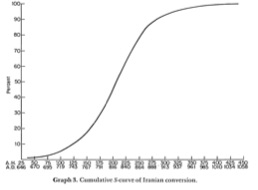
First book first. Biographical dictionaries were, interestingly enough, a widely-cultivated genre in many pre-modern Islamic countries. Each of these would give a large number of biographies of people (usually men) who were eminent or remarkable in some respect, such as religious scholars in a particular city or district. Part of those biographies would of course be the full name of the figure, which, in Arabic, included a chain of patronymics, of the form "A, the father of Z, the son of B, the son of C, ... the son of M". (Thus the pioneering social scientist generally known in English as "ibn Khaldun" was more properly 'Abd-ar-Rahmân Abû Zayd ibn Muhammad ibn Muhammad ibn Khaldûn, 'Abd-ar--Rahmân, the father of Zayd, the son of Muhammad, the son of Muhammad, the son of Khaldûn.) Bulliet's starting point is to suppose that the first appearance of an Arabic and especially of a Quranic name in this chain marks the family's conversion to Islam. (As a Persianist, he knows very well that later Muslims had little compunction about naming their children, say, Rustam or Tahmina.) Since the biographical dictionaries give dates, at least dates of death, with some reassonable-sounding guesses about the length of generations, typical age of conversion, and so on, this lets him work backwards to the approximate date of conversion of each patrilineage. (Since the same biographical dictionary will often contain multiple entries for relatives, one would want to (i) cross-check conversion dates, and (ii) only count each conversion once; I believe Bulliet does so but I can't find the passage.)
You can then chart the fraction of all known conversions which took place in a given time window. This is what Bulliet gets when he does this for "Iran", i.e., all Persian-speaking areas:

This looks even more impressive when plotted cumulatively:

(Click on either image to embiggen.)
As Bulliet says, this is a textbook-quality fit to a logistic curve, which is exactly what you'd expect from the simplest diffusion-of-innovations model. (In terms of epidemic models, an SI model.) I am legitimately impressed, and will certainly use this the next time I teach that subject. [Update: So I did.] (Though I have also acquired enough of the statistician's carping, quibbling spirit that I'd want to see how much different choices about things like generation time would alter his results.)
Bulliet goes on to construct similar curves for other parts of the Muslim world --- Spain, Egypt, Syria, Iraq --- but admits that the data aren't as great, partly because of the quality of the sources, and partly because it's harder to use linguistic clues to identify conversions in those regions. (As he says, Spain is an exception here.) These are broadly similar in their shape, though timing is a bit different from one place to another.
The historical interpretation Bulliet builds on these findings is given briefly in Conversion, and considerably more elaborated in View from the Edge. This is that the Muslim community in fact grew fairly slowly at first, even when large territories had been incorporated into the caliphate. The new Muslims, he argues, tended to move to cities which were sites (initially) of Muslim garrisons (sometimes being founded as such), creating an unusually urban religious environment. Figuring out what it meant to be a Muslim, in this environment, was largely regulated by the hadith, the traditions concerning the Prophet and his companions, which became central to Islamic education and religion. View gives a very detailed account of how the hadith were transmitted and used, how both transmission and use changed over time, and how they came to be compiled in books rather than in oral tradition --- a change, he notes, that seems to have first taken root in Iran. Lots of the customs and institutions that became broadly characteristic of Muslim societies were, on Bulliet's account, products of "the edge", these frontiers of conversion, and especially Iran. These began to spread more broadly, he says, only after the process of conversion in Iran was largely complete, on the far side of the century or so when most of the conversions happened. Thus for instance the earliest madrassas founded outside Iran, for instance, were heavily loaded towards having Iranian professors, or non-Iranians who were themselves the immediate students of Iranian scholars.
Of all this, I will just say that it sounds very plausible, but it's far beyond my competence to evaluate. §
Andrew Elfenbein, The Gist of Reading
An attempt to synthesize what psychologists know about how people read today, and especially what they remember of what they read, with literary-critical concerns about how they should read, and literary-historical interests in how people have read. As an outsider to all the disciplines involved, I found it fascinating, and a model of engaged, modest interdisciplinarity. §

Books to Read While the Algae Grow in Your Fur; Pleasures of Detection, Portraits of Crime; Enigmas of Chance; Data Over Space and Time; Writing for Antiquity Islam; Biology; Scientifiction and Fantastica; The Commonwealth of Letters; The Progressive Forces; Tales of Our Ancestors; The Beloved Republic; Heard About Pittsburgh PA; Minds, Brains, and Neurons; Philosophy; Commit a Social Science

Posted at April 30, 2020 23:59 | permanent link

April 22, 2020

A Very Introductory Lecture on Epidemic Models

Attention conservation notice: Should you really be learning about epidemiology from someone who has to consciously inhibit an urge to turn everything into an Ising model?

I'm teaching data mining this semester, but The Kids were understandably interested in epidemic modeling, so I gave a lecture on it for the special-topics day in the syllabus. They liked the slides, and some people who saw them did to, so if you want a basic introduction the classic susceptible-infectious-removed model of epidemics, and how it plays with network structure, here you go.

Suggestions for improving them are welcome, since it seems very likely that I'll be teaching "data over space and time" again in the fall (assuming, inshallah, that there is a fall semester), and it'd be strange not to cover this topic.

Corrupting the Young; Enigmas of Chance; Networks; Biology

Posted at April 22, 2020 21:26 | permanent link

March 31, 2020

Books to Read While the Algae Grow in Your Fur, March 2020

Attention conservation notice: I have no taste, and no qualifications to opine about mathematical biology, the history of science, or comparative sociology and political science.

Jane Haddam, Fighting Chance
Mind candy mystery novel: the 29th, and sadly last, of her Gregor Demarkian series. This is the only one where the solution, while logical, "fair" and completely unexpected, did not feel right. (I refrain from saying any more to avoid spoilers.) It is also, as this profile notes, one where the background crime, outrageous though it sounds, was entirely real, and it's astonishing that it did not end in murder.
Nicolas Bacaër, A Short History of Mathematical Population Dynamics
This is very much a scientist's history of science, rather than a historian's. It consists of a series of very brief chapters, most of just a few pages, giving thumbnail biographies of historical figures, and explaining their contributions in modern terminology and notation. It begins with Fibonacci and his series, noting that this had absolutely no influence on any later work at using mathematics to understand population. The real development begins with stuff like life tables and actuarial calculations, Malthus and population growth, and so on. The re-appearance of the basic reproductive number in numerous contexts is a running, though not exactly high-lighted, theme. Developments in data collection (e.g., comprehensive censuses by states effective enough to actually count people, ascertain their ages, etc.) are mentioned only in passing, though without such data there would be nothing to model. The most fully developed historical study is actually one of the last, in the chapter on China's one child policy, in which a bunch of control engineers, cut off from the broader scientific community, manage to re-invent key ideas of demography, derive radical conclusions from their models, and get men in power to act on them.
I learned from this, I appreciate its perspective and its brevity, and I'd assign it to my students if they were curious, but I'd also like to see something more historically serious.
Meg Gardiner, UNSUB, Into the Black Nowhere, The Dark Corners of the Night
Mind-candy thrillers, psycho-killers-and-profilers flavored. Competitive with Shadow Unit as high-quality Criminal Minds pastisches.
Brian D. Ripley, Spatial Statistics
On the one hand, this is from 1981, so all the detailed computational advice is laughably obsolete. (At one point, Ripley discusses strategies for not having to keep all of a 128 kb image in main memory at once.) There has also been a lot of advances in some aspects of the theory, notably for point processes. On the other hand, Ripley's basic advice --- visualize; do less testing for "randomness" and more model-building; simulate your models, visualize the simulations, and test modeling assumptions with simulations and visualizations; smooth, and remember that "kriging" is just the Wiener filter --- remains eminently sound.
--- I have been reading bits and pieces of this book, off and on, since around 2000, but I have a rule about not recommending something until I've finished it completely. Having finally now read it all, including the chapter on tomography (!), I can safely say: anyone seriously interested in spatial statistics probably ought to read this, but you can skip the tomography chapter as obsolete. I have to say that the idea of paying the list price for the paperback is outrageous, but lots of potential readers will have access to Wiley's online version, which is a perfectly decent scan of the printed book.
Victor LaValle, The Changeling
Magical-realist urban fantasy, about being a parent in contemporary New York. It's intense, but it's great because it honors the genre conventions of both literary fiction (the attention to character; language that tries to renew the perception of the ordinary world) and urban fantasy or horror (creepy, thrilling supernatural weirdness).
Göran Therborn, What Does the Ruling Class Do When It Rules?
A collection of long, tightly-linked essays from the 1970s, attempting to formulate a serious Marxist sociology of the state and of political authority. The starting point is his answer to the title question, which is, roughly, that the ruling class, through the state, acts to reproduce the social conditions for its own dominance. This basic thought is then elaborated with a wealth of historical and sociological examples, and a lot of intelligence given to ideas like different modes of state organization being different forms of technology, and different "formats of representation".
Therborn's over-all answer is a reasonable one, but not without its difficulties. There are two which especially struck me while reading, one of which he could have fixed fairly easily (intellectually if not personally), the other, I think, is more fundamental.
  1. Therborn quite properly includes the post-1917 Communist states as examples of states with a definite class character, and analyzes how they acted to reinforce the dominance of the ruling class. These analyses are, however, completely undermined by his conviction that the ruling class in those states was the proletariat, which collectively appropriated the surplus for its own use. This was, of course, nonsense, and was easily observed to be nonsense at the time. Therborn even admits that management, Party officials, etc., are not exactly the proletariat and look an awful lot like a ruling class, but insists that they weren't, all appearances and his own criteria to the contrary notwithstanding. A more clear-eyed advocate of Therborn's own theoretical positions should, I think, have frankly admitted that the Party and the technocracy together constituted a new ruling class, engaged in collective expropriation of the surplus for its benefit and in ensuring the reproduction of its own conditions of domination. In other words, Therborn should have endorsed the thesis of Djilas's The New Class. Reading between the lines, I'm sure this would have been personally unacceptable to Therborn, at least at the time of writing, but it's where his logic should have taken him.
  2. The more serious problem, to my eyes, is the cognitive one. Therborn assumes that the ruling class knows how to reproduce its rule, but in reality it would need to figure out how to do this. Even if we suppose that the ruling class (and/or its state) wants to advance its interests, it's not obvious what concrete courses of action will do that, let alone do it well. Presumably it doesn't wait for Comrade Therborn to come along and tell it, and presumably it doesn't secretly employ historical materialism in its innermost councils, so what does it do? (Cf. Dewey.) How do these ideas about what the ruling class and its state should do become effective for real, concrete individuals? What mechanisms keep those individuals in line with class interest? What happens when the ruling class and/or the state are wrong about what will advance their interests? I am tempted, on Therborn's behalf, to advance a selectionist explanation: ruling classes don't have Marxometers pointing them in the right direction, so they try all kinds of things, but the ones which are wrong about how to secure the reproduction of their domination will cease to rule, so we'll only observe ones which were right. (Cf. Quine's "Creatures inveterately wrong in their inductions have a pathetic but praiseworthy tendency to die before reproducing their kind".) But changes in ruling classes are rare, so there'd be little evolutionary information in the signal of their failures (as in footnote 2 to my critique of Ober), so there would need to be some kind of selection at the level of practices or policies, and I don't see the feedback channel which would tell the state apparatus "stop doing that, it's not helping the dominant class reproduce itself". (There are plenty of other feedback channels.) In any case, such selectionism is entirely against the "feel" of Therborn's mode of argument.
To repeat, there's a lot of interesting historical and sociological material in here, arranged by an intelligent and honest partisan in support of some fixed convictions. I'd be very curious to see how Therborn's thoughts have moved on since 1978. (This edition is a 2008 reprint without any new material.) §
Chelsea Cain et al., Man-Eaters (1, 2, 3)
Warren Ellis et al., The Wild Storm (1, 2, 3, 4)
Victor LaValle et al., Destroyer
Comic-book mind candy. Man-Eaters is a very broad satire about what would happen if the onset of menses caused teenage girls to turn into literal man-eating were-panthers. The Wild Storm is Ellis giving a familiar kaleidoscope (ancient aliens, secret space programs and hidden governments, personified electricity as the animating spirit of the 20th century) another shake. Destroyer melds some of the concerns about black parentage LaValle explores in The Changeling with a sequel to Frankenstein.
The Americans
A serial about a family of prosperous, hard-working immigrants raising kids in the DC suburbs in the 1980s, with complicated feelings about America and the Americanization of their children, might as well have been targeted at me.

Books to Read While the Algae Grow in Your Fur; Scientifiction and Fantastica; Pleasures of Detection, Portraits of Crime; Enigmas of Chance; Commit a Social Science; The Progressive Forces; Writing for Antiquity; Biology; Data over Space and Time

Posted at March 31, 2020 23:59 | permanent link

March 30, 2020

Of the Evaluation of Expertise ("I am not so good for that as an old roofer")

Attention conservation notice: A 2000-word reaction to conferences in 2011 where too many people wanted impossible things of social science and data mining, and too many people seemed eager to offer those impossible things. Too long by more than half, too pleased with itself by much more than half, it lacks constructive suggestions and even a proper ending. To the extent there's any value to these ideas, you'd be better off getting them from the source I am merely parroting. Left to gather dust in my drafts folder for years, posted now for lack of new content.

Q: You have an old house with a slate roof, right?

A: You know that perfectly well.

Q: Does the roof ever need work?

A: You just said it's old and slate, and I live in Appalachia. (In the Paris of Appalachia; but still, in Appalachia.) Of course it does.

Q: Do you do the work yourself?

A: I have no idea how; I hire a roofer.

Q: How do you know the roofer knows what he's doing?

A: I am not sure what you mean. He fixes my roof.

Q: Well, does he accurately estimate where leaks will occur over the next year?

A: No.

Q: Does he accurately estimate how much the roof is going to leak each year?

A: No.

Q: Does he accurately estimate how many slate tiles will crack and "need replaced" each winter?

A: No.

Q: OK, so he's not much into point forecasts, I can get behind that. Does he give you probability forecasts of any of these? If so, are they properly calibrated?

A: No. I don't see where this is going.

Q: Everyone agrees that the ability to predict is a fundamental sign of scientific and technological knowledge. It sounds like your roofer can't predict much of anything, so what can they know? You should really hire someone else, preferably someone well-calibrated. Does Angie's list provide roofers' Brier scores? If not, why not?

A: I don't believe they do, I can't see why they should, and I really can't see how knowing that help me pick a better roofer.

Q: It's your business if you want to be profligate, but wouldn't it help people who do not enjoy wasting money to know whether supposed experts actually deserve to be taken seriously?

A: Well, yes, but if you will only listen to roofers who are also soothsayers, I foresee an endless succession of buckets under leaking ceilings.

Q: So you maintain a competent (never mind expert) roofer needn't be able to predict what will happen to your roof, not even probabilistically?

A: I do so maintain it.

Q: And how do you defend such an obscurantist opinion? Do you suppose that a good roofer is one who enters into a sympathetic human understanding with the top of the house, and can convey the meaning of a slate or a gutter?

A: Humanist-baiting is cheap even for you. No, when it comes to roofs, I am all about explanation, and to hell with understanding. (People are different.) But an expert roofer no more needs to predict what happens to the roof than an expert engineer needs to predict how a machine they have designed and built will behave. Indeed, it would be a bizarre miracle if they could make such predictions.

Q: And why would a plain, straightforward prediction be such a wonder?

A: However expert the roofer is about the roof, or the engineer about the machine, what happens to them depends not just on the object itself, but the big, uncontrolled environment in which it's embedded. You will allow, I hope, that what happens to my roof depends on how much rain we get, how much snow, etc.?

Q: Not being a roofer, I don't really know, but that sounds reasonable.

A: Might it not also matter how many sunny days with freezing nights we have, turning snow on the roof to ice?

Q: Sure.

A: And so on, through contingencies I'm too impatient, and ignorant, to run through. But then, to predict damage to the roof, doesn't the roofer need to not only know what condition it started in, but also all the insults it will be subjected to?

Q: That does seem reasonable. (But aren't you asking a lot of questions for "A"?)

A: (Shut up, I explain.) So your soothsaying roofer must be a weather-prophet, as well as knowing about roofs. And the same with the engineer and their machine: they would need to foresee not just the environment in which it will be put, but also the demands which its users will place upon it. It sounds very strange to say that such prophetic capacities are a necessary part of expertise in roofing, or even engineering.

Q: It might sound strange; many true things sound strange; indeed, doesn't every science become more and more un-intuitive and strange-sounding as it progresses? It sounds strange to lay-people to say that the economy consists of one immortal, lazy, greedy, infinitely calculating person, who does all the work, owns all the assets, and consumes all that the goods, but just think of the triumphs of successful prediction which the macroeconomists have achieved on this basis! If we abandon the criterion of prediction just because it sounds strange, how shall we ever distinguish an expert roofer from a mere pundit of the slates?

A: Perhaps by seeing if they can do the things roofers are supposed to do.

Q: Such as?

A: Well, when something goes wrong with the roof, they should be able to diagnose what caused the problem, and in favorable cases prescribe a course of action which will fix it, and even carry out the operation.

Q: Do you only call in the roofer when something has gone wrong? Your house must be in a sad state if so.

A: No, a good roofer should also be able to diagnose situations which, while they cause no immediate problem, are apt to lead to problems later.

Q: There can be few of those if you should have a winter without rain, which, you must admit, is possible. Are you not just sneaking back in my probabilistic forecasts, which you poured such scorn on before, with your "sooth-sayers" and your "weather prophets"?

A: Not at all; it's enough to recognize conditions which would cause problems under a broad range of circumstances which there is some reason to fear. Apprehension about the effects of a meter of snow sitting atop the roofer for three months on end is not reasonable in Pittsburgh; expecting even ten days in the winter without some precipitation is folly. At the very most, I am calling for some ability to say, conditional on typical weather, what consequences should be expected; the problem of giving a distribution for the weather is no part of the roofer's expertise.

Q: And next I suppose that you will pretend that prescription doesn't rest on prediction?

A: It certainly requires knowledge of the form If we do X, then condition Y will result; but if we do X', then Y'. Such conditional knowledge, about roofs, is actually immensely easier for a roofer to acquire, than for them to learn the whole huge multidimensional distribution of all the environmental factors which could influence the state of a roof, and their dependencies over time. But it is the latter which you are presuming, with your Brier scores and your notion of what sort of prediction is an adequate sign of knowledge. And what the roofer cannot foretell about the roof, neither can the engineer about the machine, nor the doctor about the patient, nor the natural scientist about their object of study.

Q: You insist that scientists do not make predictions?

A: In your unconditional, categorical, absolute sense, certainly not. Scientists certainly possess all sorts of conditional knowledge, about what would happen, if certain conditions were to be imposed, certain manipulations were to be made. Unconditional predictions, even unconditional probabilistic predictions, are for the most part beyond them.

Q: So a chemist cannot predict the course of a chemical reaction? Don't bother dodging with contaminants, or mis-labeled reagents.

A: Me, quibble? No. But even with pure, known reagents in a sealed reaction vessel at STP --- well, you were a student at Berkeley, where the chemistry labs are a block or two downhill of the Hayward Fault. I don't think you could have said what would have happened if there'd been a tremor in the middle of one of your experiments.

Q: You can't think it's fair to ask a chemist to predict earthquakes, can you?

A: My point exactly. To put it formally, in terms of Pearl, you could know \( \Pr\left(Y\middle |\mathrm{do}(X=x)\right) \) exactly, for all \( x \), but not know \( \Pr\left(Y\middle|X=x\right) \), still less \( \Pr(Y) \). (The Old Masters of Pittsburgh would say: you can know the distribution of \( Y \) after "surgery" to remove incoming edges to \( X \), without knowing the un-manipulated distribution of \( Y \).) But it is the last which you are insisting on, with your calibrated forecasts and prediction as the sign of expertise.

Q: Well, astronomers make such predictions, don't they?

A: I defy you to find a single other science which can also do so. Even then, our astronomy's successes merely testify to our engineering's weaknesses. When our descendants (or the cockroaches'; no matter) become able to move around comets, or move planets, or build Dyson spheres and Shkadov thrusters, even the predictions of celestial mechanics will become contingent on the interventions of sentient (I will not say "human") beings.

Q: Even in those science-fictional scenarios, the choices of human (or post-human or non-human) beings would be functions of their microscopic molecular state, and so physically predictable, so shouldn't —

A: I indulged in science fiction as a rhetorical flourish, but now you are seriously arguing on the basis of technical impossibilities, sheer metaphysical conjecture and even mythology.

Q: Never mind then. Suppose, for the sake of argument, that I accept that someone could be a knowledgeable expert without making predictions. Surely you would agree, though, that someone who makes a lot of predictions which turn out to be wrong definitely doesn't know what they're doing?

A: I can think of at least one way in which that fails, which is that when they also have effective control.

Q: Better control means un-predictability? This I have to hear.

A: Suppose I want to maintain a constant temperature in my house. I look at the sky, guess the day's weather, and turn on the air conditioner or the furnace as needed. If I express myself by saying "It's miserably humid and the sun isn't so much shining as pounding, the house will be intolerably hot", you will point out, at the end of a day during which the air conditioner labored heroically and the electric bill mounted shockingly, that the house was in fact entirely comfortable, and say not only that I can't predict anything worthwhile, but that, empirically, you see no particular relationship between the weather outside the house and the temperature inside it.

Q: Aren't you creating an air of paradox, simply by being sloppy in expressing the prediction? It's really "The house will be intolerably hot today, unless I run the AC".

A: Granted, but we can only ever check one branch of the condition. And I can be completely accurate in predictions about what would happen, absent imposed controls, even if none of those things actually happen, because of my forecast-based control.

--- I never did figure out how to end this.

Enigmas of Chance; Commit a Social Science; Constant Conjunction Necessary Connexion

Posted at March 30, 2020 09:50 | permanent link

March 10, 2020

Ebola, and Mongol Modernity

Attention conservation notice: An old course slide deck, turned in to prose on the occasion of a vaguely-related news story from 2014. Not posted at the time because it felt over-dramatic. I have, of course, no authority to opine about either world history or epidemiology, and for that matter no formal training in networks.

Exhibit A

One of the books which most re-arranged my vision of the past was Janet Abu-Lughod's Before European Hegemony: The World System A.D. 1250--1350. It gave me the sense, as few other things have, of historical contingency, or more exactly of modernity as a belated phenomenon, and changed my teaching. She depicts an integrated (part-of-the-) world economy, an "archipelago of towns" linked by trade-routes stretching from Flanders to Hangzhou and centered in the Indian Ocean. This archipelago is where modernity should have begun. Beyond the market-oriented, urban-centered economy, China has the beginnings of an industrial revolution (a point explored by Mark Elvin in his Pattern of the Chinese Past, and his sources in Japanese scholars of Chinese economic history, and emphasized by William McNeill in his Pursuit of Power); the beginnings of a truly global perspective. All of this was politically supported by the unification of the most economically and technologically advanced regions (namely China and the Islamic world) under the Mongol Empire, admittedly at the cost of the occasional "shock and awe" campaign, destruction of Baghdad, etc.

Exhibit B

So what, according to Abu-Lughod, happened? What happened was Yersinia pestis, the bubonic plague, a bacterium transmitted by fleas that live on rodents. It long has been, and is, endemic to the rodents of Central Asia, such as the giant gerbil Rhombomys opimus, which seems to be perpetually perched at the edge of the epidemic threshold. The Mongol Empire didn't just unify the most advanced parts of Eurasiafrica; it brought them into intimate contact with Central Asia. And then, as usual, the plague followed the routes of trade and imperial travel:

It's impossible to know just how deadly it was, but estimates put it at around 25% of global population; up to 90% in some regions. It destroyed (according to Abu-Lughod) the world economy, that "archipelago of towns", leaving isolated and barely-functional fragments which could be dominated and re-purposed by western European pirates/traders poking into the post-pandemic landscape.

One aspect to this is how slowly, and how progressively, the plague spread. It took decades to spread from Central Asia to the peripheral region of western Europe, where it chewed steadily across the landscape:

As my old friend and sometime co-author Mark Newman and collaborators puts it, this is strong evidence that "the small-world effect is a modern phenomenon". The small-world effect, after all, is that the maximum distance between any two people in the social network of size $n$ grows like $O(\log{n})$. This implies that the number of people reachable in $d$ steps grows exponentially with $d$, which is hardly compatible with the steady geographic progress of the disease.

The argument here is so pretty that I can't resist sketching it. Suppose that every infected person passes it on to any one of their contacts with probability $t$, at least on average. We start the infection at a random person, say Irene, who selects a random one of their acquaintances, say Joey, for passing it on. The probability that Irene, or any other random person, has $k$ contacts is, by convention, $p(k)$. But Joey isn't a random person; Joey is someone reachable by following an edge in the social network. Joey's degree distribution is $\propto k p(k)$, since people with more contacts are more reachable. Specifically, Joey's degree distribution is $k p(k) / \langle K \rangle$, where $\langle K \rangle \equiv \sum_{k=0}^{\infty}{k p(k)}$, the average degree. If Joey gets infected, the number of additional infections he could create is up to $k-1$. So our initial random infection of Irene creates, on average, $t \sum_{k=1}^{\infty}{k(k-1)p(k)}/\langle K \rangle = t \langle K^2 - K\rangle / \langle K \rangle$ at one step away. At $d$ steps, we've reached $ \left(t \langle K^2 - K\rangle / \langle K \rangle \right)^d$ nodes. So long as $t > \langle K \rangle / \langle K^2 - K\rangle$, this is exponential growth:

If $t$ is above this critical level, the only way to avoid exponential growth is to have lots and lots of overlapping routes to the same nodes. [Some people might've had 1024 ancestors ten generations back, but most of us didn't.] Geographic clustering will do this, but the small-world effect makes it very hard to avoid. And the small-world effect is very much a part of modernity; whether the diameter of the social network is six or twelve or twenty is secondary to the fact that it's not a thousand.

Exhibit C

Zeynep Tufekci, "The Real Reason Everyone Should Panic: Our Global Institutions are Broken" (23 October 2014):
The conventional (smart) wisdom is that we should not panic about Ebola in the United States (or Europe). That is certainly true because, even with its huge warts, US and European health-care systems are well-equipped to handle the few cases of Ebola that might pop up.
However, we should panic. We should panic at the lack of care and concern we are showing about the epidemic where it is truly ravaging; we should panic at the lack of global foresight in not containing this epidemic, now, the only time it can be fully contained; and we should panic about what this reveals about how ineffective our global decision-making infrastructure has become. Containing Ebola is a no-brainer, and not that expensive. If we fail at this, when we know exactly what to do, how are we going to tackle the really complex problems we face?
Climate Change? Resource depletion? Other pandemics?
So, I have been panicking. ...
Globalization, in essence, means we really are one big family, in sickness and in health.
The more connected we are, the easier it is for a virus to spread wide and deep, before we get a chance to contain it.
And that is partially why Ebola is now ravaging through three countries in West Africa: it broke through in cities and large-enough settlements, and due to an accumulation of reasons, including recent civil wars, at a time when they were least equipped to handle it.
Containing an outbreak requires circumscribing the outbreak (isolating and treating the ill, tracing their contacts, isolating and treating them as well) so that it can no longer find new hosts, and healing those who are ill, or mourning those who die. Circumscribing an outbreak is easier when the cases are a few, or a few dozen, or a few hundred.
In fact, we know from previous Ebola outbreaks which parameter brings down the dreaded transmission rate: "the rapid institution of control measures." It’s that simple.
After thousands of cases, this gets harder and harder.
After millions, it is practically impossible.

Of course, Ebola got under control (in 2014). It took far too much misery and fear and time, but it happened. But it left no sign that the powers that be had learned any lessons, about (to quote Tufekci again) either "basic math [or] basic humanity".

The Mongols, at least, had the excuse that they had no idea what they were doing. (It's not as though Nasir al-din al-Tusi had, between doing theology and pioneering Fourier analysis, worked out how network connectivity related to the likelihood of epidemic outbreaks.) Compared to them, our predecessors in globalization, we are as gods; we're just not very good at it.

Networks; Writing for Antiquity; The Continuing Crises; The Great Transformation; The Natural Science of the Human Species

Posted at March 10, 2020 23:46 | permanent link

February 29, 2020

Books to Read While the Algae Grow in Your Fur, February 2020

Attention conservation notice: I have no taste, and no qualifications to opine about epidemiology, sociology, or the history of ideas. Also, I'm writing book reviews during faculty meetings downtime.

István Z. Kiss, Joel C. Miller and Péter L. Simon, Mathematics of Epidemics on Networks: From Exact to Approximate Models
My attempt at a summary grew to a full-length review (which needs a better title).
Erik Olin Wright, How to Be an Anticapitalist in the Twenty-First Century
This is Wright's last book; it continues a long and (unironically) proud tradition of socialists re-writing the Manifesto: start by saying why capitalism sucks, while admitting some of its virtues; then explain how it can be bettered; identify the existing social force(s) which will replace it; and talk about how those forces will undertake the revolution. Wright says sound things about how capitalism molds people into selfish jerks (or crushes them), is undemocratic and (for most) unfree, and offends basic notions of fairness. (He sensibly refrains from asserting that capitalism either causes or requires racism, sexism, imperialism, etc., which is at the very least a highly debatable generalization, though of course racist and sexist capitalists can be expected to exploit workers in racist and sexist ways on top of everything else.) He then sketches what he'd like to see instead, which is a market economy with lots of public provision, some collective ownership, and a lot of worker and consumer cooperatives. Fantasies of central planning are, rightly, not part of his socialist vision. (He does not touch on the delicate problem of how to coordinate the democratic decisions of the members of a cooperative with the democratic decisions of the wider socialist commonwealth when the two disagree [e.g., about whether or not to shut down an oil company], or how to delineate the right scale for the cooperatives [is the oil company one cooperative, or does each rig, refinery and gas station become its own cooperative?].) He also delineates different ways of attacking or at least trying to replace capitalism, ranging from frontal assaults by violent revolution to separatist utopian communities to temporary carnivals of defiance to quietly trying to build alternative institutions that can grow to take over the larger capitalist ecosystem, a sort of vision of socialism as algal bloom. (That is not his image.) The end of the book looks at what would be required for a "collective actor" to try to effect such a transformation --- and there it ends, with a promise that he was just about to say how the trick would be turned.
We will never get to hear Wright's thoughts about how to solve that last riddle, because he died while the book was still incomplete, and what we have here was polished to publication, but not exactly completed, by friends and disciples. This is a fitting tribute to a scholar of real distinction, who made his reputation by combining sound* sociology with unorthodox, "analytical" Marxism that wasn't afraid to actually think, and who tried to remain connected to real-life struggles for a better world. §
*: More waspishly, no worse, methodologically, than the rest of post-1960s American sociology.
Jane Langton, The Memorial Hall Murder, Natural Enemy, Good and Dead, Murder at the Gardner
Classic mysteries from the early 1980s, where the very particular settings, and often specific works of literature or art associated with them, are just as important as the murders. I read all these as a boy, but return to them now with delight, and perhaps more appreciation for their non-murder-mystery aspects. (For instance, Good and Dead is also a fine novel about the decline of "mainline" Protestantism, which rather passed me by as a teenager.) --- Subsequently in the series. §
Kwame Anthony Appiah, Lines of Descent: W. E. B. Du Bois and the Emergence of Identity
A fine study of what Du Bois took from German thinkers of the 18th and 19th centuries, especially from German Romanticism and from the "professorial socialism" of his teachers in Berlin. It'd probably help to have at least read The Souls of Black Folk (which Appiah suggests we could gloss as "the geist of the black volk"), but Appiah's exposition is so skillful that no deep knowledge of either Du Bois's life and work, or of German thought, is really needed.
--- There is a longer story here, which Appiah hints at, at how relevant early Romantic nationalism (like Herder) remains for contemporary ideas in fields like "ethnic studies", despite gestures towards acknowledging the internal heterogeneity and diversity within any such "community". (It's easy to see how a Herderian would be upset by "cultural appropriation", and hard to give a coherent account of the offense otherwise [cf. Richard Thompson Ford, Racial Culture: A Critique].) Whether this is historical continuity of tradition, and if so whether Du Bois was one of the channels of transmission, or whether on the contrary it is parallel re-evolution, would be a fascinating thing to know. §
Allison Brennan, If I Should Die
Mind-candy thriller: in which outsiders try to start a legitimate business in a deeply criminal town in upstate New York, and plot ensues. A bunch of the soap-opera among the characters presupposing reading the earlier books in the series. (To be clear, I enjoy the soap opera.)
Tarquin Hall, The Case of the Reincarnated Client
Mind-candy mystery, the latest installment in Hall's "Vish Puri" series in contemporary Delhi. Delightful as always, and I think full enjoyable without the prior installments. (Read before sectarian riots in Delhi became topical again.)
Walter Jon Williams, Quillifer the Knight
Mind candy fantasy, but high quality mind candy. Quillifer (introduced in the book of that name) is an opportunistic social climber with a tragic backstory and a supernatural nemesis in a formerly-medieval fantasyland undergoing a renaissance. He's charming, deceptive, clever, realistically concerned with money and finance, and a convincing mixture of scoundrel and creature of his own conscience. I suspect that Williams owes some debt to such Renaissance-setting competence-porn as Hilary Mantel or Dorothy Dunnett, but as always he makes the material fully his own, so it's not just "Wolf Hall with magic".

Books to Read While the Algae Grow in Your Fur; Pleasures of Detection, Portraits of Crime; The Progressive Forces; Commit a Social Science; Writing for Antiquity; Scientifiction and Fantastica; Networks; Enigmas of Chance; Complexity

Posted at February 29, 2020 23:59 | permanent link

January 31, 2020

Books to Read While the Algae Grow in Your Fur, January 2020

Attention conservation notice: I have no taste, and no qualifications to say anything about Iranian history, political philosophy, sociology, or American literature and art.

Abbas Amanat, Iran: A Modern History
The title is, of course, a pun. On the one hand, it's a "modern" history because it's not an ancient or medieval one: it begins with the founding of the Safavid empire around 1500, and continues down to the now-abrogated nuclear deal with the US. (Bad decisions by mad and/or decadent rulers is one of his themes for a reason.) But it's also a modern history because Amanat is up-to-date on the scholarship about everything, and it's all here: high politics and its personalities and swings of fortune, village life and its rhythms and transformations; economic history across regions and centuries; the interplay between urbanism and nomadism, and the impact of motor cars on both; literature and philosophy, painting and movies, music and architecture; secular and religious law; the decline and growth of Iran's knowledge of the outside world, and the growth of orientalist scholarship on Iran and on Persianate culture more generally; Iranian imperialism (across multiple dynasties) and its rivals, Ottoman, Mughal, Uzbek, Portuguese, Dutch, French, British, Russian, Soviet and American; and of course religion. (Amanat is especially sensitive to the enduring role of messianic and millenarian movements in this history, going all the way back to the Safavids themselves.) It's a dazzling display of learning and sympathy, but also of skillful exposition. It's hard to imagine there's a better general history of Iran currently available. If you have time, read it before we start bombing.
W. G. Runciman, Great Books, Bad Arguments: Republic, Leviathan, and The Communist Manifesto
Runciman is a sociologist, distinguished for having worked out a genuinely evolutionary theory of social change (specifically, of the differential reproduction of social practices). This book is not about that. Rather, it's about an elderly, eminent sociologist, long interested in political philosophy, revisiting some of the classics of political theory and saying (more eloquently) "What were you guys smoking?" I am pleased to see that Runciman finds The Republic as baffling as I do, and his strictures against Hobbes, and against Marx and Engels, are for the most part sensible. His last chapter tries to rescue these books, on the grounds that they're not trying to be accurately descriptive nor ideally (idly?) normative, but "optative", hopeful. I am not sure even this can save Plato.
Linda Nagata, Silver
Far-future space opera. This is a direct sequel to Nagata's Edges, in which some of the characters from that novel find themselves on an artificial world which has been the site of a role-playing game going on for millennia. The world is now buggy, in plotful ways, and the megalomaniacal post-human entity who helped make it is about to return, much to the detriment of the really-very-nearly-human players, if not of everyone else in local space. Exploration, trickery, time dilation, improvisation, crop-dusting, self-pity, firmly-held misconceptions, journeys through the underworld and heart-break ensue.
As I've said before, Nagata is, to my taste, one of the best of her generation of hard-SF writers. Silver doesn't have the quite the same sense of cosmic strangeness and scale as Vast (which may be her masterpiece), but it's still really good, and shows (again) that she also has the talent to paint on a smaller scale.
(I feel compelled to note that while Nagata is a science-fiction author of a certain age, and this book unites the story-worlds of her "Nanotech Succession" series and Memory, she shows no other signs of brain-eater syndrome.)
Franco Moretti, Far Country: Scenes from American Culture
A version of what is (apparently) Moretti's long-run undergrad course on American literature and culture. Some of Moretti's characteristics are here --- he's really big on comparisons between multiple examples of genres, so there's a (brilliant) chapter contrasting Westerns with film noir, but it's definitely a contrast between the genres, rather than between any particular Western and any particular film noir. But I guess not even Moretti wanted to teach intro. lit. to freshmen through distant reading.
Paul Barnetson, Critical Path Planning: Present and Future Techniques (Princeton: Brandon/Systems Press, 1970, reprinting the London: Buttersworth, 1968 edition)
You may be amused, or horrified, to learn that when I was a small boy, my father the development economist used to tell me to always think about the "critical path" when planning my activities --- to figure out what part of the over-all project would take the longest to complete, and make sure everything else would fit inside that time. I don't remember how old I was when I first heard this, but it was definitely before he taught me linear programming, which was when I was 10 or 12. To this day, I feel vaguely guilty if I start preparing a tea-pot before setting water to boil.
When I ran across this little book (six years older than I am) at a sale, I couldn't resist seeing how close what I'd been taught was to the genuine article. If you ever need a short (102 page), clear explanation of the critical path method, aimed at reasonably smart but not very mathematical managers, complete with 1960s-vintage computer output, here you are. It's... not that different from what I learned as a boy, and now I don't know whether to be amused or horrified myself.
Tess Gerritsen
  1. The Apprentice
  2. The Sinner
  3. Body Double
  4. Vanish
  5. The Mephisto Club
  6. The Keepsake
  7. Ice Cold
  8. The Silent Girl
  9. Last to Die
  10. Die Again
  11. I Know a Secret
Mind-candy psycho-killer thriller novels. While not the apex of their genre, the fact that I read them all in a month shows they obviously do instill the "I need to find out what happens next" urge. (But they also instilled no desire to go back and read the first book in the series, or Gerritsen's other stuff.)

Books to Read While the Algae Grow in Your Fur; Pleasures of Detection, Portraits of Crime; Scientifiction and Fantastica; Philosophy; Commit a Social Science; Afghanistan and Central Asia; Islam and Islamic Civilization; Writing for Antiquity; The Beloved Republic; The Commonwealth of Letters; Mathematics

Posted at January 31, 2020 23:59 | permanent link

January 29, 2020

"Data science methods to reduce inequality and improve healthcare" (Also Next Week at the Statistics Seminar)

Attention conservation notice: Announcement of a highly technical talk, in a subject you're not interested in, at a university you're not near.

Emma Pierson, "Data science methods to reduce inequality and improve healthcare"
Abstract: I will describe how to use data science methods to understand and reduce inequality in two domains: criminal justice and healthcare. First, I will discuss how to use Bayesian modeling to detect racial discrimination in policing. Second, I will describe how to use machine learning to explain racial and socioeconomic inequality in pain.
Time and place: 4--5 pm on Wednesday, 5 February 2020, in Hamerschlag Hall B103

As always, talks are free and open to the public.

Enigmas of Chance; Commit a Social Science

Posted at January 29, 2020 13:45 | permanent link

January 28, 2020

"The Blessings of Multiple Causes" (Next Week at the Statistics Seminar)

Attention conservation notice: Announcement of a highly technical talk, in a subject you're not interested in, at a university you're not near.

I am very much looking forward to our first talk of the semester, which I am sure will evoke lively discussion:

Yixing Wang, "The Blessings of Multiple Causes"
Abstract: Causal inference from observational data is a vital problem, but it comes with strong assumptions. Most methods assume that we observe all confounders, variables that affect both the causal variables and the outcome variables. But whether we have observed all confounders is a famously untestable assumption. We describe the deconfounder, a way to do causal inference from observational data allowing for unobserved confounding.
How does the deconfounder work? The deconfounder is designed for problems of multiple causal inferences: scientific studies that involve many causes whose effects are simultaneously of interest. The deconfounder uses the correlation among causes as evidence for unobserved confounders, combining unsupervised machine learning and predictive model checking to perform causal inference. We study the theoretical requirements for the deconfounder to provide unbiased causal estimates, along with its limitations and tradeoffs. We demonstrate the deconfounder on real-world data and simulation studies.
Time and place: 4--5 pm on Monday, 3 February 2020, in Hamerschlag Hall B103

As always, talks are free and open to the public.

Enigmas of Chance; Constant Conjunction Necessary Connexion

Posted at January 28, 2020 12:06 | permanent link

Three-Toed Sloth